Guide to Vehicle Ownership Transfer in Punjab 2026
Buying or selling a car should feel exciting, not stressful. Yet many people get stuck because they do not understand the vehicle ownership transfer Punjab process. A small mistake can delay the transfer, cause fines, or even create legal trouble later. This guide removes that confusion. It gives you clear, practical steps so you can complete the transfer with confidence and peace of mind.
Whether you are a first-time buyer or selling a vehicle after years of use, ownership transfer is not optional. It is a legal duty. Until the transfer is completed, the previous owner remains responsible for taxes, challans, and accidents. This article explains the full process in simple language, so you know exactly what to do and when.
You will learn the complete flow, from document preparation to final verification for Vehicle Ownership Transfer in Punjab, without guessing or relying on agents.
- Online vehicle ownership transfer
- Using the MTMIS and Excise portals
- When online transfer is allowed and when it is not
- Offline vehicle ownership transfer
- Visiting the Excise & Taxation office
- Biometric verification and file submission
- Transfer fees and taxes
- Cost based on engine size
- Common hidden charges to avoid
- Required documents
- Original registration book or smart card
- CNIC copies of buyer and seller
- Biometric verification requirements
By the end, you will know how to complete vehicle ownership transfer Punjab correctly, without delays or legal risk.
Understanding Vehicle Ownership Transfer in Punjab
Buying or selling a vehicle feels complete when money and keys change hands. But legally, it is not done until the records are updated. This step protects both the buyer and the seller from future trouble.
Vehicle ownership transfer Punjab refers to the legal process of moving a vehicle’s registration from one person or entity to another. In Punjab, the Excise & Taxation Department keeps the official record of who owns a vehicle. Until that record changes, the old owner remains responsible in the eyes of the law.
This transfer is mandatory because traffic fines, taxes, accidents, and even criminal misuse are all linked to the registered owner. Many people face problems years later simply because they skipped this step after a sale.
Why this legal transfer matters:
- Confirms who is legally responsible for the vehicle
- Protects the seller from fines or legal notices after sale
- Allows the buyer to pay token tax and apply for services
- Prevents disputes during resale or verification
- Keeps Excise records accurate and up to date
If you are planning to sell or buy, it is wise to understand the official requirements first.
When Is Vehicle Ownership Transfer Required?
Ownership transfer is not only for simple buying and selling. It is required in several common real-life situations, and skipping it can cause delays or legal stress later.
Here are the main cases where transfer is compulsory:
- Private vehicle sale
When a vehicle is sold between two individuals, the buyer must complete the excise office process to become the legal owner. - Inherited vehicles
If the owner passes away, heirs must transfer the vehicle into their name before using or selling it. - Company to individual transfer
Vehicles moved from a business name to a personal name must be officially transferred. - Gifted vehicles
Even if no money is involved, records must still be updated. - Out-of-province registration change
When a vehicle is moved and registered under Punjab permanently.
If your situation matches any of these, do not delay. Starting early helps avoid penalties and extra visits.
Eligibility and Preconditions for Vehicle Ownership Transfer
Before you begin a vehicle ownership transfer, it helps to know one thing clearly: not everyone can apply, and not every vehicle is eligible right away. Checking these basics first saves time, money, and repeated visits to the office.
Both the seller and buyer must meet simple legal conditions. The vehicle must also be clean in official records. If even one requirement is missing, the transfer can be delayed or rejected.
Who Can Apply (Eligibility Checklist)
- The registered owner of the vehicle (seller)
- The new owner (buyer) with valid identity documents
- Both parties must have valid CNICs
- Both must complete biometric verification in person
- The buyer must be legally eligible to own a vehicle
Vehicle Conditions That Must Be Met
- Vehicle must be registered in the same province
- No unpaid taxes, fees, or penalties
- No pending challans or legal cases
- Vehicle must not be reported stolen or blocked
- Original registration book or smart card must be available
Important Things to Confirm First
- Seller’s name must exactly match official records
- Engine and chassis numbers must be clear and readable
- Any prior ownership transfer must already be completed
If any detail is incorrect, fix it before applying. This prevents rejection at the counter.
Once eligibility is confirmed, you can move forward with confidence and avoid unnecessary delays in your vehicle ownership transfer.
Documents Required for Vehicle Ownership Transfer in Punjab
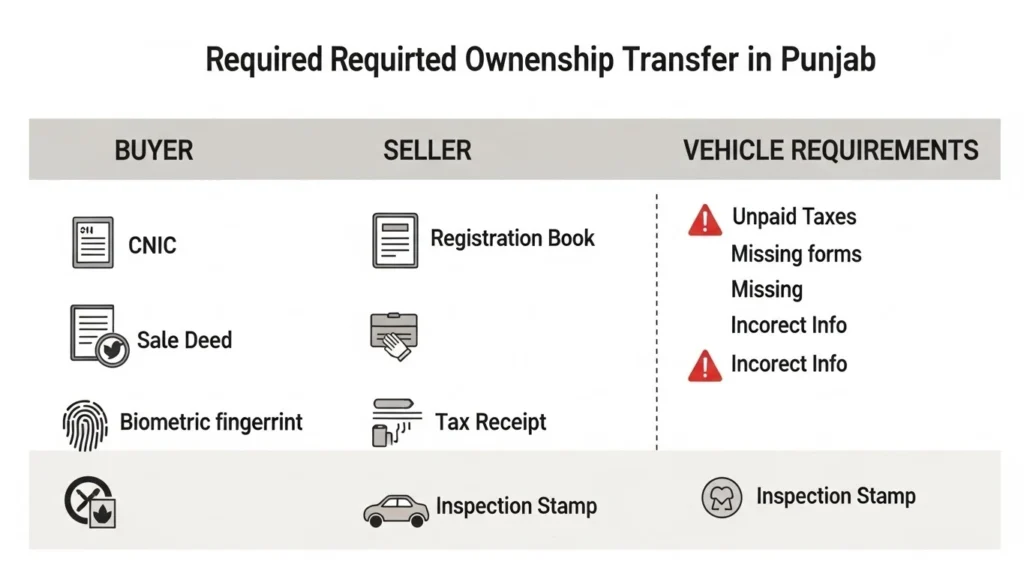
Before visiting the excise office, make sure all documents are complete. Missing even one paper can delay your vehicle ownership transfer in Punjab or force you to come back another day. Both the buyer and seller have responsibilities, and preparation makes the excise office process smooth and stress-free.
Below is a clear list of mandatory documents required for a successful transfer.
| Document Name | Provided By | Purpose |
|---|---|---|
| Original Registration Book (File/Smart Card) | Seller | Confirms legal ownership of the vehicle |
| CNIC (Original + Copy) | Buyer & Seller | Identity verification during transfer |
| Transfer Application Form | Seller | Official request to transfer ownership |
| Sale Deed / Transfer Letter | Seller | Proof that the vehicle was sold willingly |
| Buyer’s CNIC Copy | Buyer | Required to register vehicle in new name |
| Token Tax Clearance | Seller | Confirms no pending government dues |
| Biometric Verification | Buyer & Seller | Prevents fraud and fake transfers |
| Vehicle Inspection Report (if required) | Excise Office | Confirms engine and chassis details |
In some cases, additional documents may be requested. For example, company-owned vehicles need an authority letter, while imported vehicles may require custom clearance papers.
Always carry original documents, not just photocopies. The excise office process relies heavily on physical verification.
Having these documents ready ensures your vehicle ownership transfer in Punjab is completed without unnecessary delays or repeat visits.
Vehicle Ownership Transfer Fee Structure in Punjab
Understanding the Vehicle Ownership Transfer Punjab fee structure helps you avoid confusion and unexpected costs at the excise office. Many people worry they will be overcharged. In reality, the government fees are fixed. The total amount mainly depends on your vehicle type and engine capacity.
Official Government Transfer Fees
The Punjab Excise & Taxation Department sets standard charges for ownership transfer. These are not negotiable and are paid at the time of transfer.
| Vehicle Type | Approximate Transfer Fee |
|---|---|
| Motorcycle / Scooter | PKR 300 – 500 |
| Car (up to 1000cc) | PKR 1,200 |
| Car (1001cc–1800cc) | PKR 2,000 |
| Car (above 1800cc) | PKR 3,000 |
| Commercial Vehicle | PKR 3,000 – 5,000 |
Note: Fees may slightly vary by district or policy updates.
Factors That Affect the Total Cost
The transfer fee is not the only amount you may pay. Your final cost can increase due to:
- Token tax clearance if unpaid
- Smart card or registration book issuance
- Late transfer penalties if ownership is delayed
- Biometric verification charges
For example, if you buy a used car with unpaid token tax, you must clear it before completing the Vehicle Ownership Transfer Punjab process. Knowing the transfer fee structure helps you plan better and complete the process with confidence.
Online Vehicle Ownership Transfer Process in Punjab
Transferring a vehicle no longer means long queues and repeated visits. Punjab’s online system is designed to save time and reduce stress, especially for buyers and sellers who want a clear, legal transfer without confusion. If you follow the steps carefully, the process is smooth and predictable.
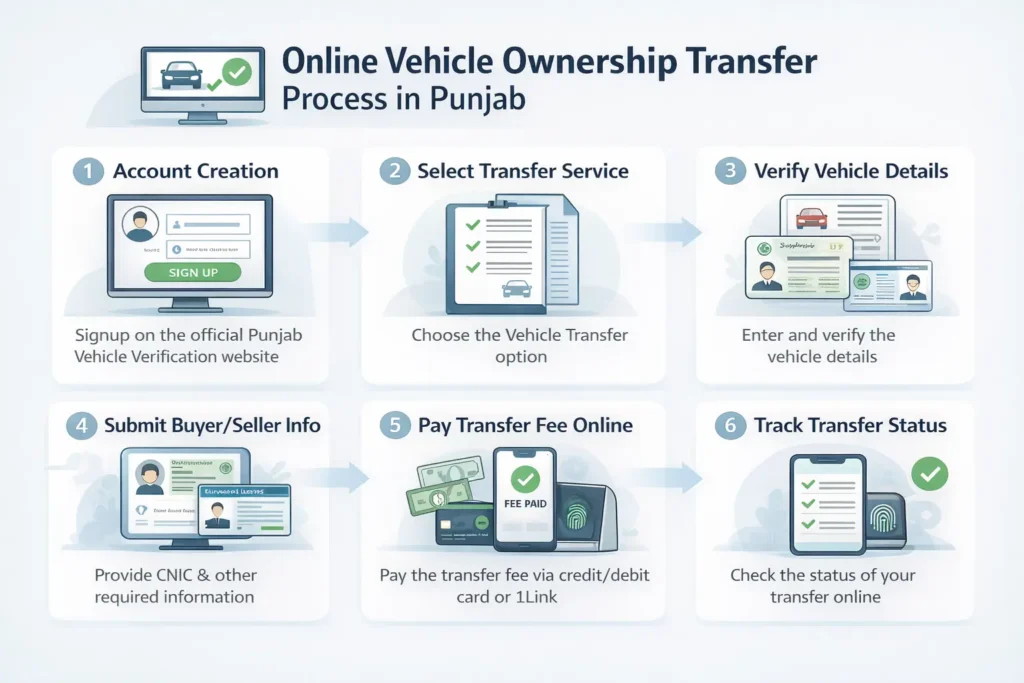
Below is the complete online vehicle ownership transfer method using Punjab Excise digital services.
Step-by-Step Online Process
1. Create or access your Excise profile
Visit the official Punjab Excise digital portal and log in using your CNIC. If you are a new user, create an account first. Make sure your CNIC details are correct, as all records link to it.
2. Select the ownership transfer service
From the dashboard, choose the option for vehicle ownership transfer Punjab services. Enter the vehicle registration number exactly as shown on the registration book.
3. Verify vehicle details
The system will display vehicle data such as engine number, chassis number, and tax status. Check everything carefully. Any mismatch should be resolved before moving forward.
4. Submit buyer and seller information
Enter CNIC details of both parties. Upload required documents, including the original registration book scan and sale receipt.
5. Pay the transfer fee online
The portal generates a challan. You can pay through online banking or approved payment channels. Keep the payment receipt saved.
6. Complete biometric verification
Both buyer and seller must complete biometric verification at a designated e-facilitation center. This step confirms identity and prevents fraud. Without biometric clearance, the transfer will not proceed.
7. Track application status
After biometrics, track your application online. Once approved, the updated ownership record is issued digitally, and the new registration book follows.
Helpful Tip : Before starting, ensure there are no pending taxes or challans. This avoids delays and rejection.
Offline Vehicle Ownership Transfer via Excise Office
If you prefer face-to-face help or your case needs manual checks, the excise office is the safest route. It removes confusion, fixes errors on the spot, and gives you official confirmation the same day in many cases.
Step-by-Step Process at the Excise Office
- Arrive early and take a token
Reach the excise office during opening hours and collect a token from the reception desk. Morning visits usually mean shorter waiting times. - Document verification counter
Go to the verification counter when your token number is called. An officer checks:- Original CNIC of buyer and seller
- Vehicle registration book or smart card
- Sale receipt or transfer application
Missing documents can stop the process here, so double-check before visiting.
- Biometric verification
Both buyer and seller complete biometric verification at the designated biometric counter. This step confirms identity and prevents fraud. If fingerprints fail, you may be guided to a NADRA desk inside or nearby. - Fee submission
After approval, move to the fee counter or bank window. Fees depend on engine capacity and vehicle type. Keep the receipt safe. - Final approval and data entry
Your file goes to the approval desk for final entry into the system. Once approved, ownership is officially transferred.
Waiting Time and Counters to Expect
- Token & verification: 20–40 minutes
- Biometric: 10–20 minutes
- Fees & approval: 20–30 minutes
Total time usually ranges from 1 to 2 hours, depending on crowd size and system load during the excise office process.
For fees, required documents, or province-specific rules, you may want to check requirements first.
This offline method is ideal if you want clarity, immediate help, and official confirmation without relying on online systems.
Biometric Verification Process for Ownership Transfer
Many people worry that biometric verification will be complicated or time-wasting. In reality, it is a simple identity check that protects both buyer and seller during an ownership transfer.
Biometric verification is required to confirm that the person selling or buying the vehicle is the same person listed on official records. It prevents fraud, fake CNIC use, and unauthorized transfers. Without biometric verification, the ownership transfer request is usually rejected.
How the biometric verification works
The process is short and usually completed in minutes:
- Both buyer and seller visit an authorized center together
- CNICs are scanned in the system
- Thumb impression is taken using a biometric device
- The system matches fingerprints with NADRA records
- Verification confirmation is issued instantly
Once successful, the ownership transfer process can move to the next step without delay.
Where biometric verification is conducted
Biometric verification is done at:
- Excise & Taxation offices
- Authorized NADRA biometric centers
- Approved service desks inside vehicle registration offices
Always confirm the center accepts biometric for ownership transfer before visiting.
Common biometric problems and quick fixes
Sometimes biometric verification fails. Common reasons include:
- Fingerprint mismatch due to worn or unclear fingerprints
- CNIC data not updated
- Recent CNIC renewal not synced in the system
What to do:
- Wash and dry hands before scanning
- Try a different finger if allowed
- Visit NADRA to update records if the issue persists
Completing biometric verification correctly saves time and avoids repeat visits.
Timeline and Processing Duration
One of the biggest worries is not knowing how long it will take. The good news is that vehicle ownership transfer usually follows a predictable timeline if your documents are complete.
Online cases are generally faster because data is submitted digitally and checked before you visit. Offline cases depend more on queues, manual verification, and the excise office process at your local office.
Here is a realistic comparison to set clear expectations:
| Transfer Method | Average Processing Time | What Affects the Timeline |
|---|---|---|
| Online transfer | 2–5 working days | Correct documents, system availability |
| Offline transfer | 5–10 working days | Office rush, manual checks, staff workload |
Delays usually happen due to missing papers, unpaid taxes, or biometric issues. If you want speed, double-check documents before starting and visit early in the day.
If time is critical, checking requirements in advance can save several days.
Common Issues and Reasons for Ownership Transfer Rejection
Transferring vehicle ownership can be straightforward, but many people face delays or outright rejections due to common mistakes. Understanding these issues helps you avoid frustration and ensures a smooth process at the excise office.
Here are frequent reasons ownership transfer applications get rejected:
- Incomplete Documentation – Missing forms like the transfer application, sale deed, or vehicle registration can immediately halt the process. Always double-check the document list before submission.
- Outstanding Fines or Taxes – Unpaid road fines, token taxes, or challans must be cleared. The excise office process requires all dues to be settled before approving the transfer.
- Incorrect or Mismatched Information – Discrepancies in the owner’s name, CNIC, or vehicle details between documents can cause rejection. Accuracy is critical to avoid back-and-forth visits.
- Encumbrances on the Vehicle – Vehicles under loan or with legal disputes cannot be transferred until clearance is obtained from the bank or relevant authority.
- Expired Vehicle Documents – Registration certificates, road permits, or inspection documents must be current. Expired paperwork often leads to delays or rejection.
- Forgery or Suspicious Signatures – Any suspicion of falsified signatures or documents triggers legal scrutiny and immediate rejection.
Being aware of these issues helps applicants prepare fully, reducing stress and ensuring the excise office process is smooth and timely. Always check requirements carefully before submission to avoid unnecessary complications.
How to Track Vehicle Ownership Transfer Status
Once you submit your vehicle ownership transfer request, it’s natural to want updates on its progress. Tracking the status ensures you stay informed and avoid unnecessary follow-ups at the excise office.
Here’s how you can easily check your transfer status:
- Visit the official excise office portal – Most provincial excise departments provide an online tracking option.
- Enter required details – Typically, you’ll need your Vehicle Registration Number (VRN) or application reference number.
- Submit and view status – The portal will display whether your transfer is pending, approved, or if additional documents are required.
- Contact the excise office if needed – For delays or unclear updates, a quick call or visit can clarify the excise office process.
Regularly checking your status helps avoid delays and ensures your vehicle documents are updated smoothly.
How to Track Vehicle Ownership Transfer Status
Navigating vehicle ownership transfer in Punjab can be tricky if you are not careful. Following practical tips helps avoid fraud, delays, and legal complications, ensuring a smooth process for both buyers and sellers.
- Verify Documents Thoroughly: Always check the original registration certificate, CNIC, and vehicle token tax receipts. Ensure there are no pending fines or unpaid taxes.
- Check Vehicle History: Confirm the vehicle’s accident and repair history. A thorough inspection prevents future disputes.
- Use Official Channels: Complete the transfer only at the local Excise and Taxation office. Avoid unofficial agents to reduce risk of fraud.
- Get a Transfer Receipt: Always obtain a proper transfer receipt. It serves as proof that the ownership transfer process has started.
- Mutual Agreement on Payment: Ensure payment is completed only after verifying all documents and before signing the transfer form.
- Stay Aware of Legal Deadlines: Punjab law requires ownership transfer within a specified period to avoid penalties.
Following these tips makes vehicle ownership transfer Punjab safe, fast, and legally secure.
Final Checklist Before Completing Vehicle Ownership Transfer
Before finalizing your vehicle ownership transfer in Punjab, it’s essential to double-check all requirements to avoid delays or legal issues. Missing even a single document can complicate the process, so this checklist ensures a smooth transfer.
Final Checklist:
- Verify that both buyer and seller have valid CNICs.
- Ensure the original vehicle registration book is complete and accurate.
- Confirm all pending taxes, fines, or challans are cleared.
- Obtain a signed and stamped sale agreement between both parties.
- Check that the vehicle’s roadworthiness certificate (if required) is up to date.
- Collect the NOC from the financing bank if the vehicle is under a loan.
Following this checklist guarantees a hassle-free vehicle ownership transfer Punjab and prevents future disputes.
FAQs About Vehicle Ownership Transfer in Punjab
Navigating vehicle ownership transfer can be confusing. Here are the most common questions answered clearly to save you time and stress.